

Product information
Permanent formwork:
- The perfect solution for saving time and money when casting suspended concrete floors.
Proprietary Q-Lock® interlocking system.
- Fastest permanent formwork construction in the industry.
- The Most secure connection between panels.
- No additional clips are required.
- Suitable for installation by semi-skilled labour.
Features:
- Q-Lock® saves time on erection.
- Q-Lock® supports the weight of wet concrete and construction load.
- Q-Lock® Completely removes the need for temporary formwork.
- No need for additional reinforcing steel when used according to the supplied loading tables. Ref 193 Mesh is required only to prevent cracking.
- Suitable for use on steel, brick, and concrete structures.
- Q-Lock® greatly reduces the number of temporary propping supports required.
- Q-Lock® is easy to transport, handle, and install.
Product material specification:
- ISQ 230 grade Z200 Galvanized steel.
Design Information:
- Q-Lock® panels can be used in conjunction with additional reinforcement to increase the moment of resistance.
- Design Methods for slabs where Q-Lock® is used is the same as for conventional slab design with the Q-Lock® panels providing the tensile reinforcement.
- The propping distances for Q-Lock® vary from 1.5M to 4.0M depending on the profile and material thickness. Unpropped distances are indicated in our loading tables.
- The calculations are based on the Limited State Method (SANS 10100-1: 2000)
- SA Designs No A2016 / 00936 and F2016 / 00937
Product range:
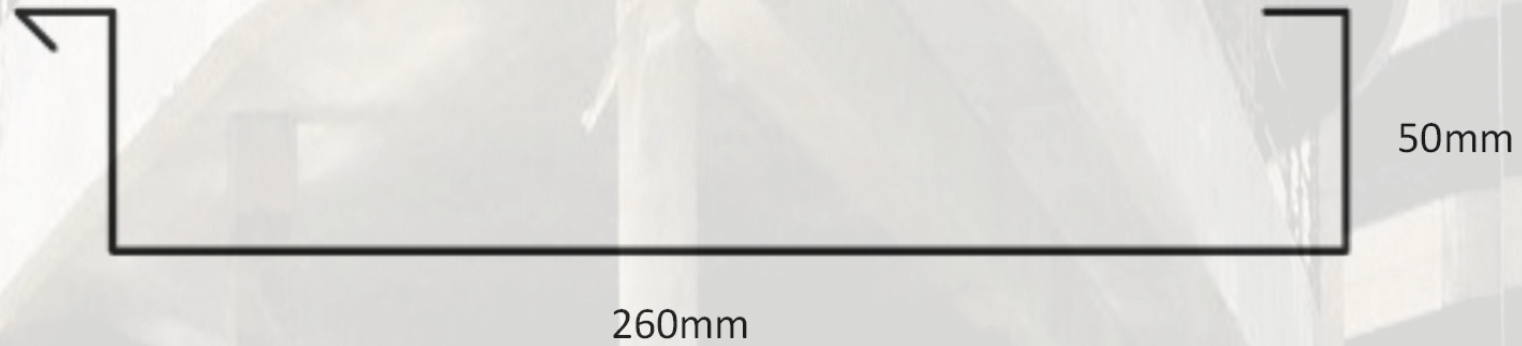
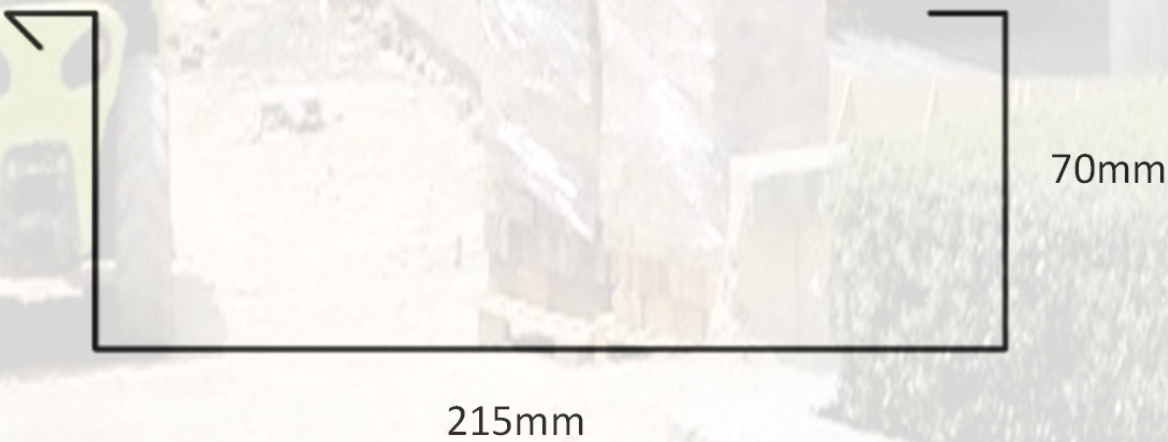
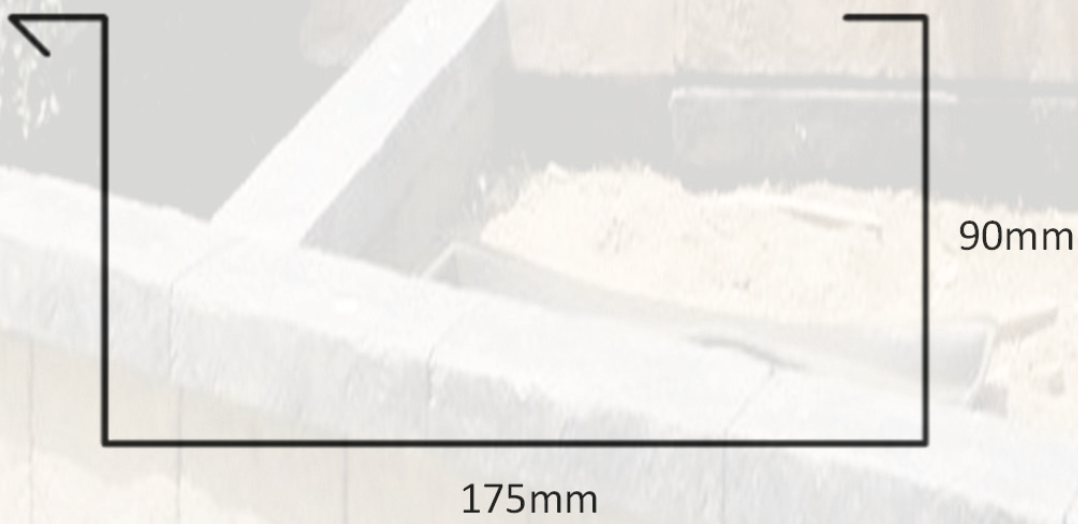
The product range consists of a standard 260mm x 50mm profile complimented by an additional range of available profiles in four different material thicknesses to suit client needs.
Q-Lock profiles can be manufactured to any requirement within a 404mm girth of material.
For quick reference and convenience, this brochure contains loading tables for the most commonly used profiles across all material thicknesses.
Standard Profile:
Special Profile Examples:
Loading Tables:
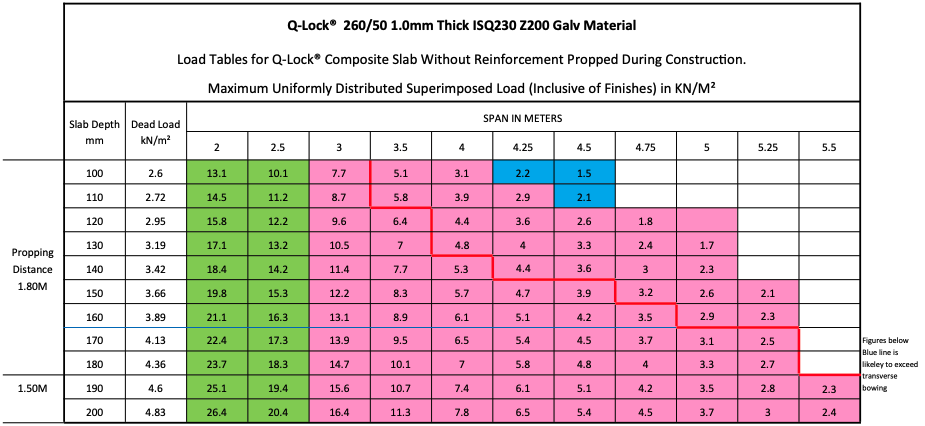
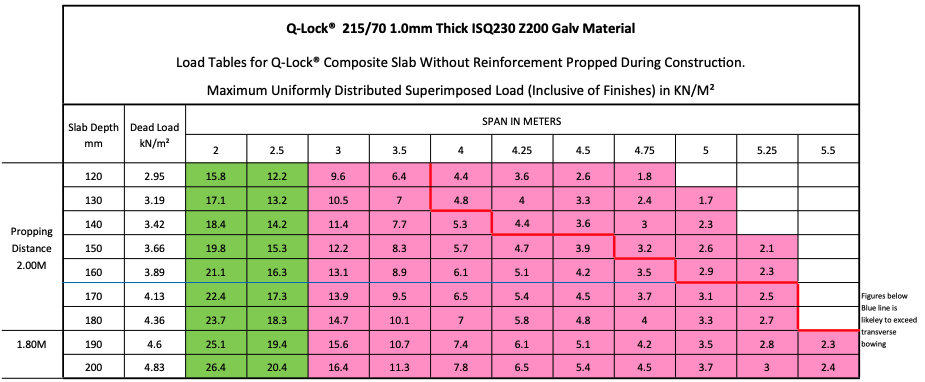
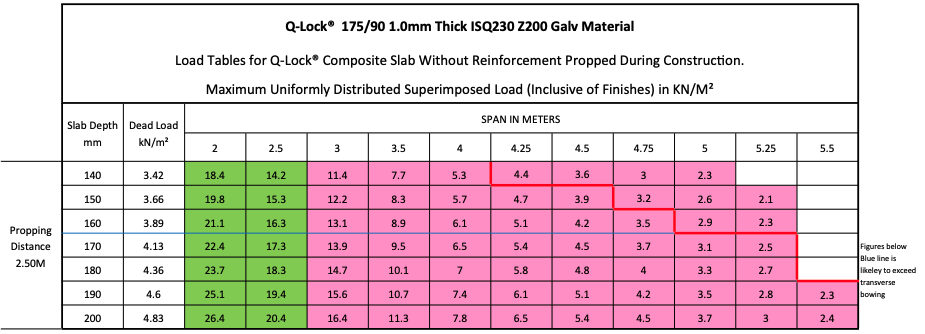
Notes
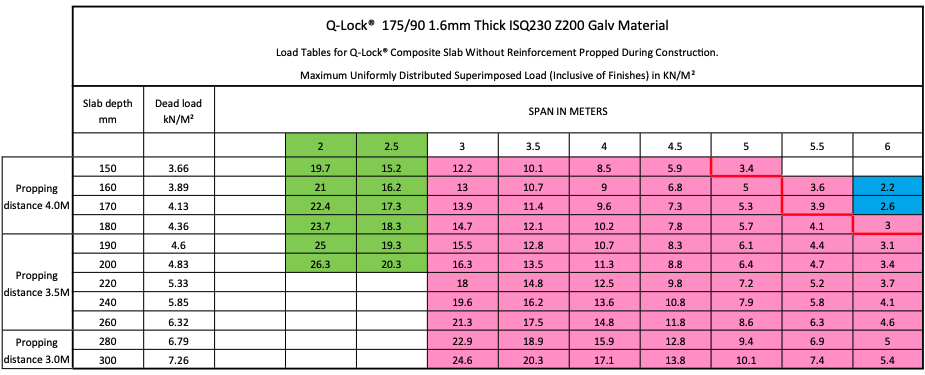
- Loads in green are determined by bond.
- Loads in pink are determined by moment of resistance.
- Loads in blue are determined by deflection under total load (span/ 250) or deflection under live load (span/ 350) but equal to or less than 20mm.
- Bold red line indicates maximum span/depth ratio @ 30.
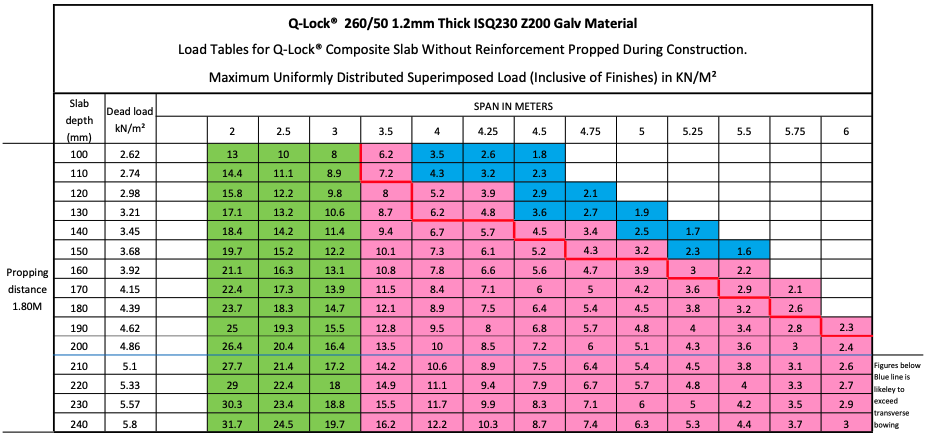
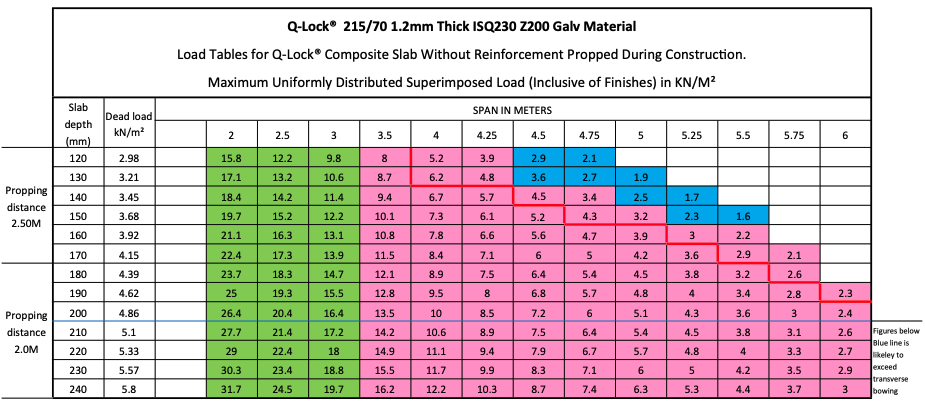
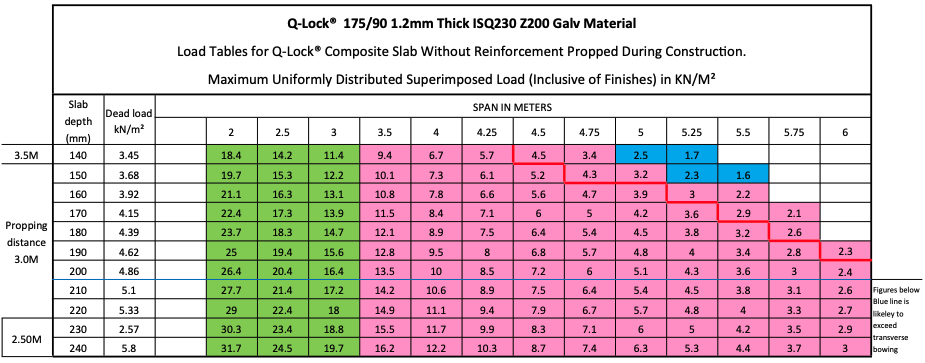
Notes
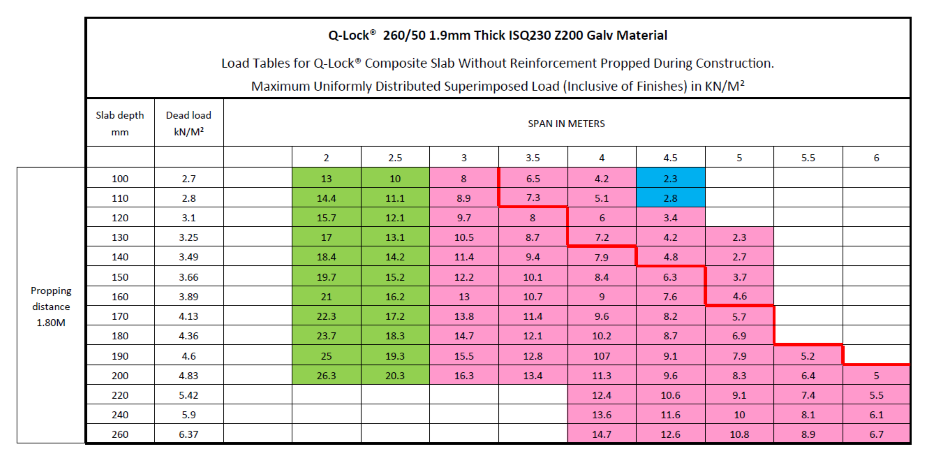
- Loads in green are determined by bond.
- Loads in pink are determined by moment of resistance.
- Loads in blue are determined by deflection under total load (span/ 250) or deflection under live load (span/ 350) but equal to or less than 20mm.
- Bold Red line indicates maximum span/depth ratio @ 30.
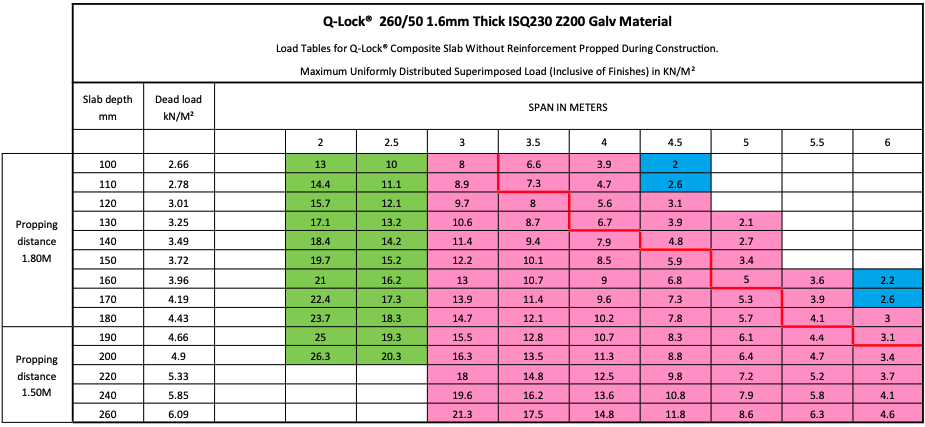
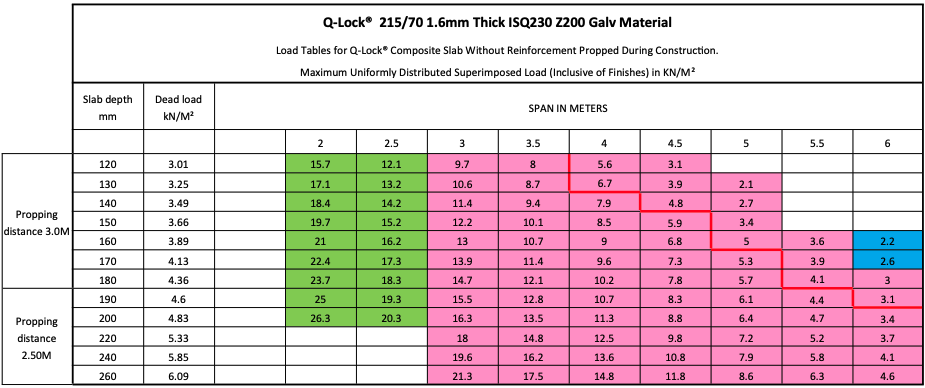
Notes
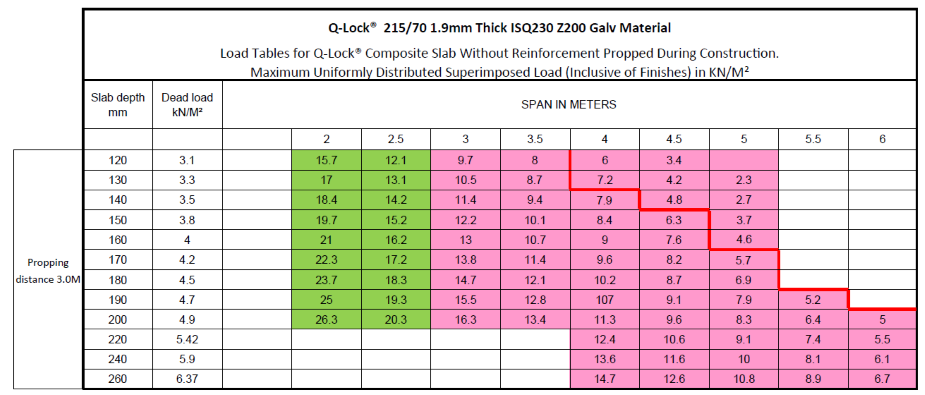
- Loads in green are determined by bond.
- Loads in pink are determined by moment of resistance.
- Loads in blue are determined by deflection under total load (span/ 250) or deflection under live load (span/ 350) but equal to or less than 20mm.
- Bold red line indicates maximum span/depth ratio @ 30.
Notes
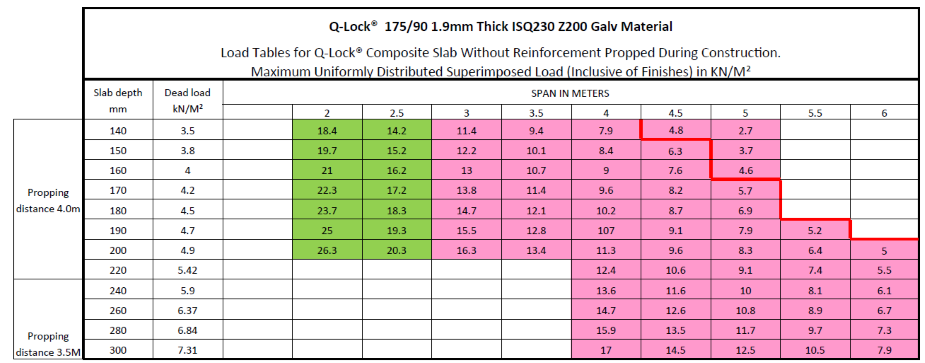
- Loads in green are determined by bond.
- Loads in pink are determined by moment of resistance.
- Loads in blue are determined by deflection under total load (span/ 250) or deflection under live load (span/ 350) but equal to or less than 20mm.
- Bold red line indicates maximum span/depth ratio @ 30.
Installation
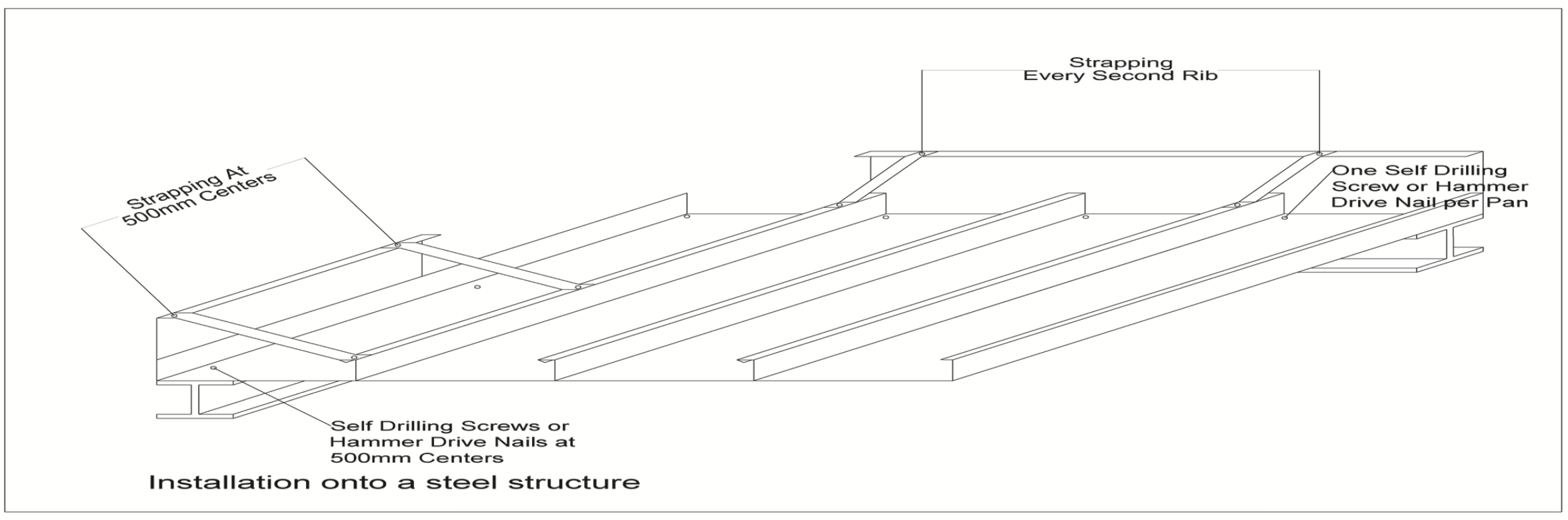
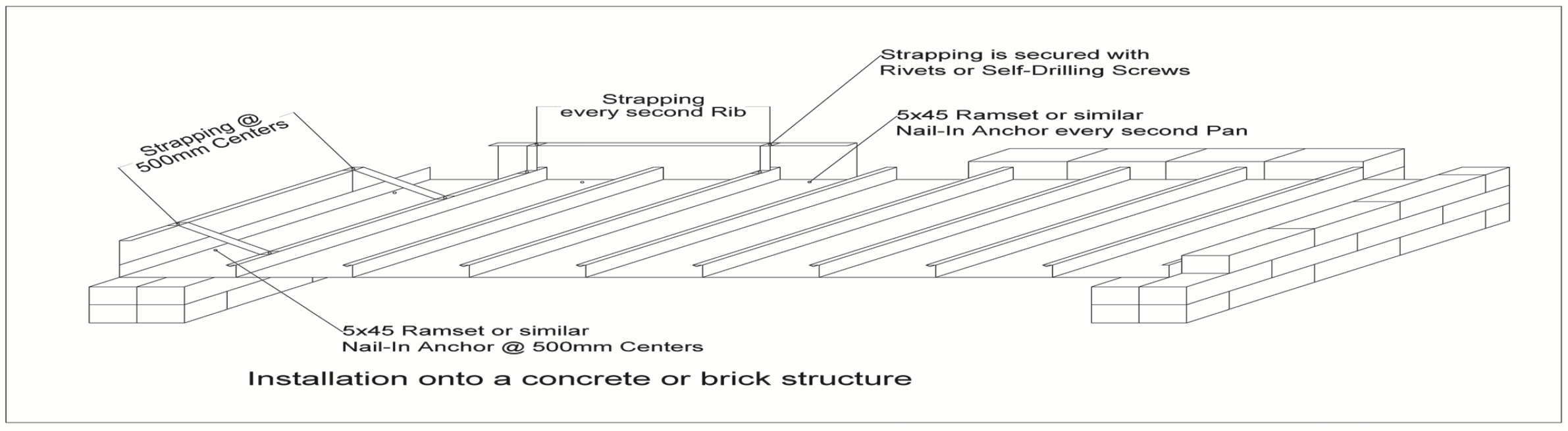
Q-Lock® panels are designed to interlock and require no further fastening between panels.
Steel:
- When installed onto a steel structure the panels are secured to the structure on every beam in every Q-Lock® pan by means of a suitable self-drilling or hammer drive screw or nail.
- A minimum 50mm end bearing is required for installation onto a steel structure.
Concrete:
- When installed onto a concrete or brick structure the lower lip of any flashing is secured by means of nail-in or similar concrete fasteners at 500mm centers.
- The Q-Lock® panels do not require any fastening to a concrete or brick structure.
- A minimum 75mm end bearing is required for installation onto concrete.
Please note: Final design is to be created and verified by a suitably qualified structural or civil engineer.
